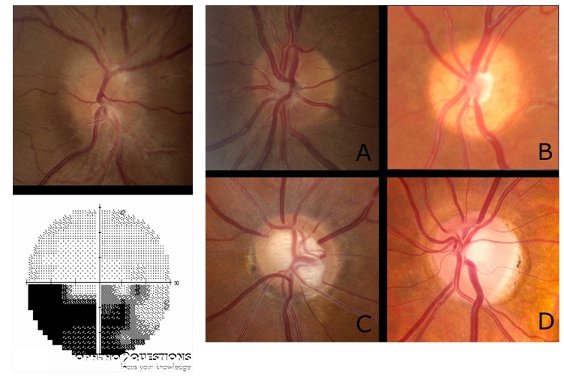
A 75-year-old male smoker with hypertension, diabetes, and peripheral
vascular disease presents to your clinic because when he awoke two days
ago he noted new onset visual field loss inferiorly in his right eye
without associated eye pain. On examination he has 20/50 vision in the
right eye and 20/20 vision in the left eye. He identified 3/9 color
plates in the right eye, 9/9 color plates in the left eye, and had a
right afferent pupillary defect. His visual field in the right eye and
right optic nerve appearance are shown above (left-sided photos). His
left eye had full visual fields. Which of the pictured optic nerves
(A-D) would you expect to see on fundus exam of the left eye?
Neuro-ophthalmology
No
U
A
The question describes a classic presentation of non-arteritic ischemic optic neuropathy (NAION).
The risk factors for NAION include vasculopathic risk factors such as
hypertension, diabetes , hypercholesterolemia, and smoking. Virtually
all patients with NAION also have crowded optic nerves (photo A)
with small cup-to-disc (C:D) ratios. It is difficult to know what a
patient's C:D ratio is once disc swelling has set in but usually optic
nerve appearance is symmetric and examination of the contralateral optic
nerve is helpful.
If the contralateral optic nerve has a C:D larger than 0.3 then the
diagnosis of NAION should be reconsidered carefully. It would be
important to reconsider occult arteritic ischemic optic neuropathy from
giant cell arteritis along with other causes of optic neuropathy in that
scenario.
Of the pictures shown, image A shows a normal optic nerve head with a small cup-to-disc ratio ("disc at risk").
Image B shows a hypoplastic optic nerve head with a classic "double
ring sign." Image C shows a glaucomatous optic nerve with prominent
cupping and a focal notch at about 5 o'clock. Image D shows mild to
moderate temporal pallor.
Heads up! You can use keyboard for test navigation: press → for Next,
← for Previous, M for Mark/Unmark, P for Pause,
R for Review, A,B,C,... or 1,2,3,... to select answer.